

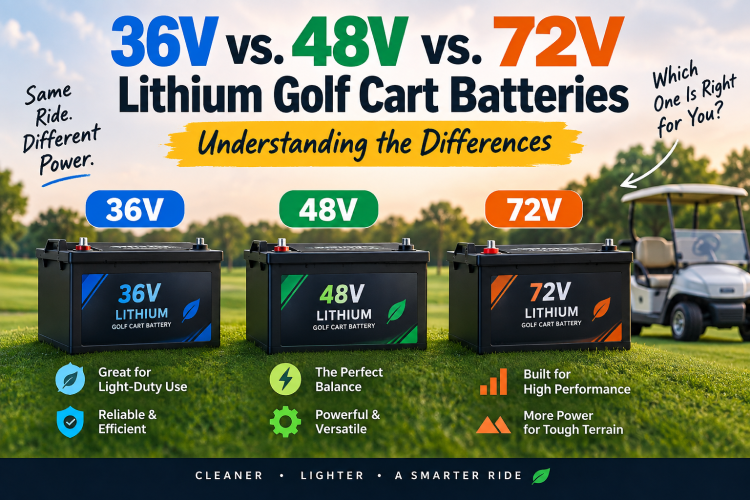
Wondering whether a 36V, 48V, or 72V lithium golf cart battery will give you the best ride? The right choice depends on your cart’s electrical system, motor, controller, battery capacity, and driving needs. Higher voltage can support more power, but it does not automatically mean better range or speed.
A 36V lithium battery suits compatible older and lighter-duty carts. A 48V lithium golf cart battery offers a common balance of power, efficiency, and practicality. A 72V lithium battery is designed for compatible high-performance or heavy-duty systems. Always match the battery to the cart before upgrading.
⚡ What Does Golf Cart Battery Voltage Mean?
Golf cart voltage describes the electrical voltage of the entire battery system. Traditional carts reach their system voltage by connecting multiple batteries in series. For example, six 6V batteries create a 36V system, while six 8V batteries create 48V. Lithium systems can simplify this setup with one complete battery pack.
Voltage affects how the cart’s electrical system delivers power. However, voltage is only one part of the equation. Motor size, controller rating, battery current, gearing, tire size, vehicle weight, and battery capacity also affect performance.
🔋 36V Lithium Golf Cart Batteries
A 36V lithium golf cart battery is commonly used in compatible older golf carts. It can provide a lighter and lower-maintenance alternative to traditional lead-acid batteries. Typical LiFePO4 packs marketed for 36V-class systems may have a nominal voltage around 38.4V. That difference comes from the lithium cell configuration rather than an incorrect battery label.
For flat courses and casual neighborhood driving, 36V can work well when the entire cart is designed for it. Lithium also provides steady power and eliminates routine watering associated with flooded lead-acid batteries. Still, switching batteries alone will not turn a 36V cart into a high-performance machine.
36V may make sense if you:
- Own a compatible older golf cart
- Mostly drive on flat ground
- Want a lighter battery setup
- Prefer a straightforward lithium replacement
- Do not need extreme acceleration
🔌 48V Lithium Golf Cart Batteries
A 48V lithium golf cart battery is widely used in modern electric golf carts. A common LiFePO4 configuration has a nominal voltage of 51.2V. This is normal and does not mean the battery is actually a 51.2V cart system.
A 48V system can provide strong performance without requiring the extreme electrical changes associated with some 72V conversions. It is suitable for many neighborhood carts, golf courses, utility applications, and recreational builds. However, the motor and controller still need to support the selected battery.
| Feature | 36V Lithium | 48V Lithium | 72V Lithium |
| Common System Class | 36V | 48V | 72V |
| Typical LiFePO4 Nominal | 38.4V | 51.2V | About 73.6V |
| Typical Use | Older/light-duty carts | General-purpose carts | Performance/heavy-duty carts |
| Conversion Complexity | Lower when staying 36V | Moderate if converting | Higher |
| Power Potential | Moderate | Higher | Very high |
🚀 72V Lithium Golf Cart Batteries
A 72V lithium golf cart battery belongs in a cart designed for a 72V electrical platform. These systems can support demanding applications, including performance-oriented builds and heavier loads. They can also reduce current needed for a given power level when the complete electrical system is properly engineered.
But 72V is not simply a bigger replacement battery. The controller, motor, charger, wiring, contactor, DC-DC converter, and other electrical components must support the voltage. Installing a 72V pack into an incompatible 36V or 48V cart can cause serious equipment problems.
📊 How Voltage Affects Power And Efficiency
Electrical power can be simplified as watts = volts × amps. This means increasing voltage can provide more power at the same current. Alternatively, the same power can be delivered with less current at a higher voltage. That can help reduce current-related electrical losses when the system is designed correctly.
However, this does not mean voltage alone determines acceleration or top speed. A weak motor or controller can limit performance even with a high-voltage battery. Think of voltage as one piece of the performance puzzle, not the entire puzzle.
🏎️ Which Voltage Offers More Speed?
Higher voltage can support higher performance, but the battery does not control speed by itself. The motor controller determines how electrical power is delivered to the motor. Motor design, programming, gearing, tire diameter, vehicle weight, and load also matter.
For example, a properly engineered 72V system can support substantially higher power than a basic 36V setup. But simply installing a 72V battery does not guarantee a faster cart. The entire drivetrain must be designed around the higher voltage.
🛣️ Which Voltage Gives Better Driving Range?
Range depends heavily on energy capacity, not voltage alone. Battery energy can be estimated using voltage multiplied by amp-hours. For example, a 48V-class battery with 100Ah has roughly 4.8kWh of nominal energy before accounting for operating conditions and usable capacity.
A larger-capacity battery can therefore outperform a higher-voltage battery in range. Terrain, passenger weight, speed, tire pressure, temperature, and driving habits also affect real-world range. When comparing batteries, look at both voltage and Ah or kWh.
🔧 Battery Compatibility Matters Most
Before ordering a lithium golf cart battery, check your cart’s required voltage. Then verify the controller’s voltage and current requirements. You should also confirm the battery dimensions, terminal arrangement, charger requirements, and cable connections.
Manufacturers and battery suppliers commonly stress that voltage alone does not prove compatibility. The charger must use a suitable charging profile, while the controller must handle the battery’s operating voltage and current.
Check these specifications before buying:
- Golf cart system voltage
- Battery nominal and operating voltage
- Controller voltage and current rating
- Motor requirements
- Battery dimensions
- Charger compatibility
- BMS discharge rating
- Warranty and installation requirements
🔋 Voltage Vs. Amp-Hours: Know The Difference
Voltage and amp-hours answer different questions. Voltage relates to the electrical system’s operating level, while amp-hours describe how much charge the battery can store. Neither specification should be used alone when comparing golf cart batteries.
Consider two batteries with the same 48V rating. One might have 50Ah, while another has 100Ah. The second battery has roughly twice the nominal energy, assuming comparable chemistry and operating conditions. That can make a major difference in potential driving range.
| Battery Example | Nominal Voltage | Capacity | Approx. Energy |
| 36V × 100Ah | 36V | 100Ah | 3.6kWh |
| 48V × 100Ah | 48V | 100Ah | 4.8kWh |
| 72V × 100Ah | 72V | 100Ah | 7.2kWh |
| 48V × 150Ah | 48V | 150Ah | 7.2kWh |
Actual usable energy and range vary by battery chemistry, BMS limits, temperature, load, and driving conditions.
💰 Cost And Installation Differences
A 36V replacement can be relatively straightforward when your cart already uses a 36V system. A compatible 48V replacement can also be simple when the cart is already designed for 48V. Problems usually arise when owners try to change system voltage without upgrading the supporting components.
A 72V conversion can involve more hardware and planning. You may need a compatible motor controller, motor, charger, wiring, and other electrical components. Therefore, compare the total conversion cost, rather than looking only at the battery’s purchase price.
🌡️ Lithium Benefits At Every Voltage
The main benefits of lithium technology apply across different voltage classes. Lithium batteries are generally much lighter than comparable lead-acid battery banks. They also avoid routine watering and can maintain a more consistent voltage during use.
Charging can also be more convenient with a properly matched lithium charger. Many modern batteries include a battery management system, or BMS, that monitors important battery conditions. Features vary by manufacturer, so check the battery’s actual specifications instead of assuming every lithium pack offers the same protection.
🧭 How To Choose The Right Lithium Voltage
Start with your existing golf cart rather than starting with the highest voltage. Check the owner’s manual, battery labels, controller information, and charger specifications. If you are replacing an existing battery, staying with the cart’s designed voltage is usually the simplest route.
If you want a different voltage, treat it as a complete electrical conversion project. Compare the motor, controller, charger, battery, wiring, and installation requirements together. This approach helps prevent expensive compatibility mistakes.
| Your Situation | Voltage To Investigate | Main Consideration |
| Older compatible cart | 36V | Simple replacement |
| Everyday neighborhood use | 48V | Balanced system |
| Heavy loads | 48V or 72V | Check motor/controller |
| Performance build | 72V | Full-system compatibility |
| Maximum range | Any compatible voltage | Compare kWh and load |
| Battery replacement | Existing system voltage | Verify exact specifications |
❓ 36V Vs. 48V Vs. 72V: What Should You Know?
The biggest difference between these lithium golf cart batteries is their system voltage and the electrical hardware designed around it. A 36V system can suit lighter applications, while 48V systems offer a common middle ground. A properly engineered 72V system can support much higher power for demanding applications.
Remember that battery voltage does not tell the whole story. Capacity, current output, motor, controller, charger, gearing, weight, and terrain all influence the final result. 🔋 The right battery is the one that matches the complete golf cart system.
🏁 Final Takeaway
Choosing between 36V, 48V, and 72V lithium golf cart batteries starts with compatibility. A 36V battery works with a compatible 36V-class cart, while a 48V battery belongs in a compatible 48V system. A 72V battery requires a properly engineered 72V platform.
Don’t choose a battery simply because its voltage number is higher. Check voltage, Ah, kWh, discharge current, BMS specifications, charger compatibility, controller rating, and physical fit. With those factors matched correctly, lithium technology can provide a lighter, cleaner, and more convenient golf cart power system.
❔ Frequently Asked Questions
What Is The Best Golf Cart Battery Voltage?
There is no single voltage that fits every golf cart. The correct choice depends on the cart’s electrical design and intended use. Always match the battery to the motor, controller, charger, and wiring.
Is A 48V Battery Better Than 36V?
A 48V system can support more electrical power at the same current. However, it is not automatically better for every golf cart. A 36V replacement may be more suitable for a cart designed around 36V.
Can I Put 72V Lithium In A 48V Cart?
Not as a simple battery replacement. A 72V battery requires compatible electrical components throughout the cart. A proper conversion may require a controller, motor, charger, and other hardware changes.
Does Higher Voltage Give More Golf Cart Range?
Higher voltage alone does not guarantee longer range. Battery energy capacity, measured in watt-hours or kilowatt-hours, is also important. Driving speed, terrain, load, and temperature affect actual range.
How Do I Choose A Lithium Golf Cart Battery?
Start by identifying your cart’s existing system voltage. Then compare capacity, discharge current, dimensions, charger compatibility, and BMS specifications. Always verify compatibility with the cart and battery manufacturer before installation.

Leave a Reply